
Recovery Platform
From handwritten paper chart to your EHR in weeks, not months
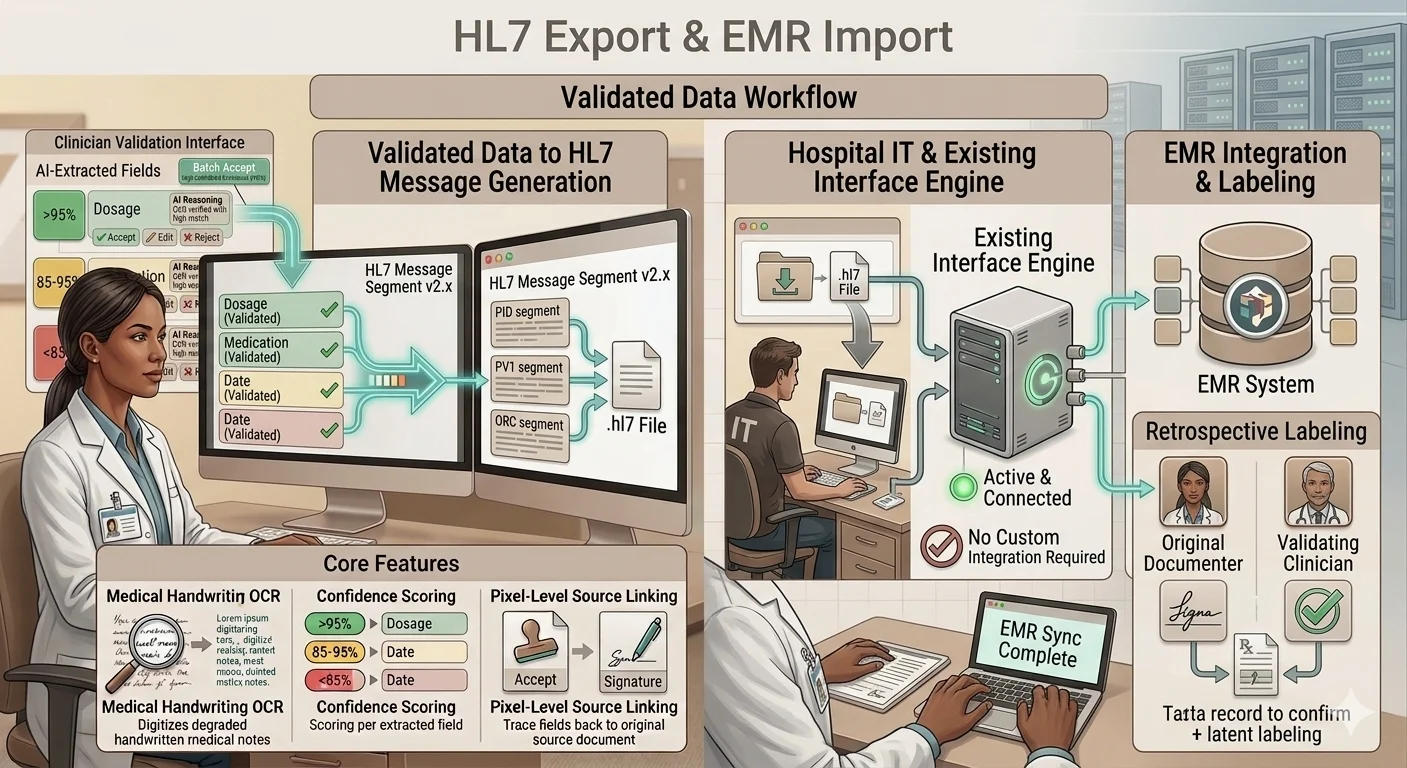
Specialist AI models classify and extract many document types from your downtime event. Clinicians validate in a side-by-side interface. Validated data generates HL7 v2.x or CSV files designed for Epic import interfaces — filed by your interface engine.
Recovery time per event
Transcription error rate
Overtime and temp staff costs
Extended outages generate thousands of paper documents
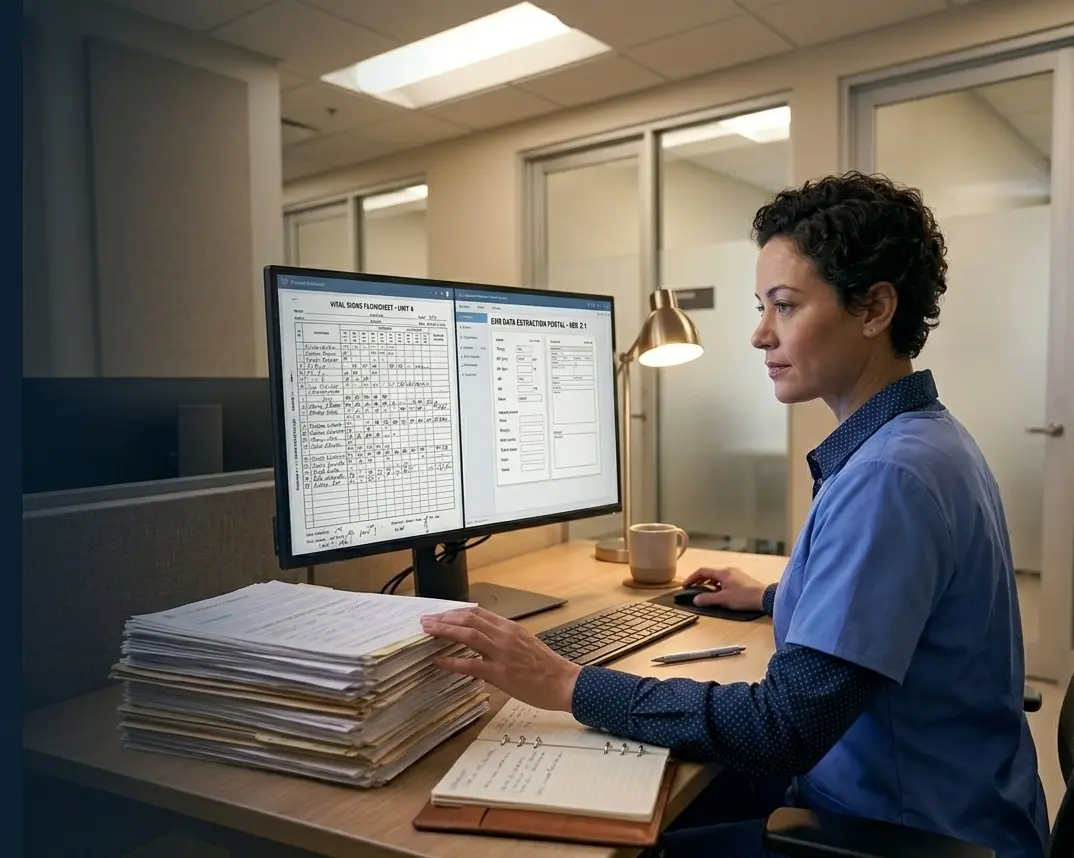
During a ransomware event or multi-day infrastructure failure, clinical staff return to paper. A 300-bed hospital running at 80% occupancy generates roughly 3,000–5,000 paper chart entries per day of downtime. A 10-day outage produces 30,000–50,000 individual documents.
After Epic restores, many of those entries must get into the EMR before patients can be safely discharged, before medications can be reconciled, and before regulatory reporting can resume. The manual approach requires 15–20 data entry staff working 60-hour weeks for 6–12 weeks — at a cost that routinely exceeds $1M in overtime and temporary staffing.
A 12–18% manual transcription error rate means a hospital generating 40,000 entries will introduce 5,000–7,000 errors into the medical record — with no systematic way to find them afterward.
Ransomware Attack
Typical duration
7–21 days offline
Documents generated
21,000–105,000 paper documents
Ascension Health (2024): 140 hospitals, 19 states, weeks of downtime
Infrastructure Failure
Typical duration
2–5 days offline
Documents generated
6,000–25,000 paper documents
Unplanned hardware or network outages — more common, less publicized
Planned Downtime
Typical duration
1–4 hours
Documents generated
50–400 paper documents
Epic upgrades, data center migrations — predictable but still generate backfill work
Four steps. Your staff focuses on care.
Lumenly does the extraction. Clinicians make the call. IT receives a standard HL7 file. No custom integration project.
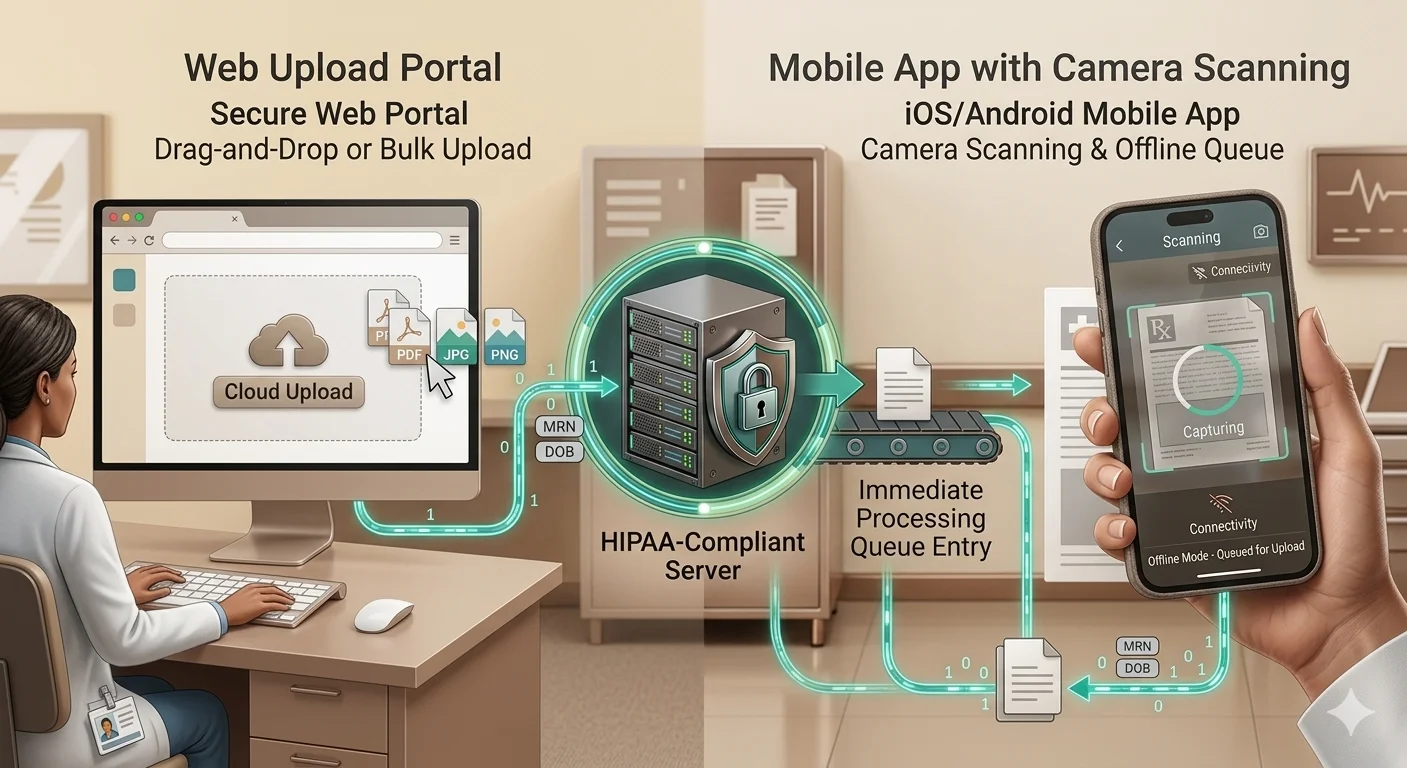
Scan and Upload
Staff photograph or scan paper charts using any device — smartphone, flatbed scanner, or document camera. Bulk upload from a hospital scanner also supported.
- Mobile app — iOS and Android
- Bulk upload from scanner via web portal
- Accepts PDF, JPG, PNG — any scan quality
- Documents tagged to downtime event automatically
- Auto-deduplication prevents duplicate processing
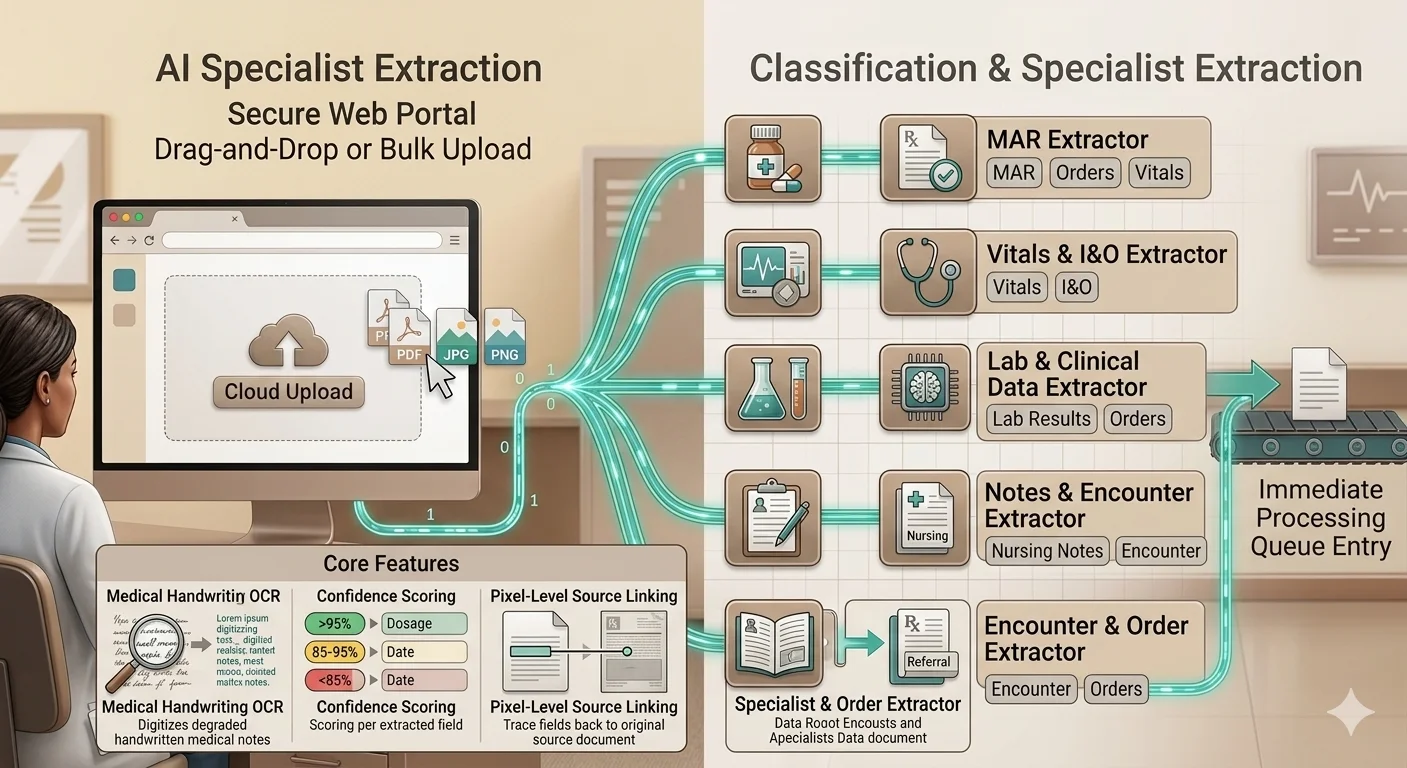
AI Extraction
Lumenly's coordinator AI classifies each document — MAR, Vitals, Orders, H&P, and 11 additional types — then routes it to a specialist extractor purpose-built for that document type. Each extracted field receives a confidence score. Low-confidence fields are flagged for clinician review.
- 15+ document type classifiers — no manual labeling
- Specialist AI models per document type — not generic OCR
- Per-field confidence scoring (High / Medium / Low)
- Medical handwriting OCR — handles degraded documents
- Nurse initials resolved against org signature library
- Medication names corrected against formulary
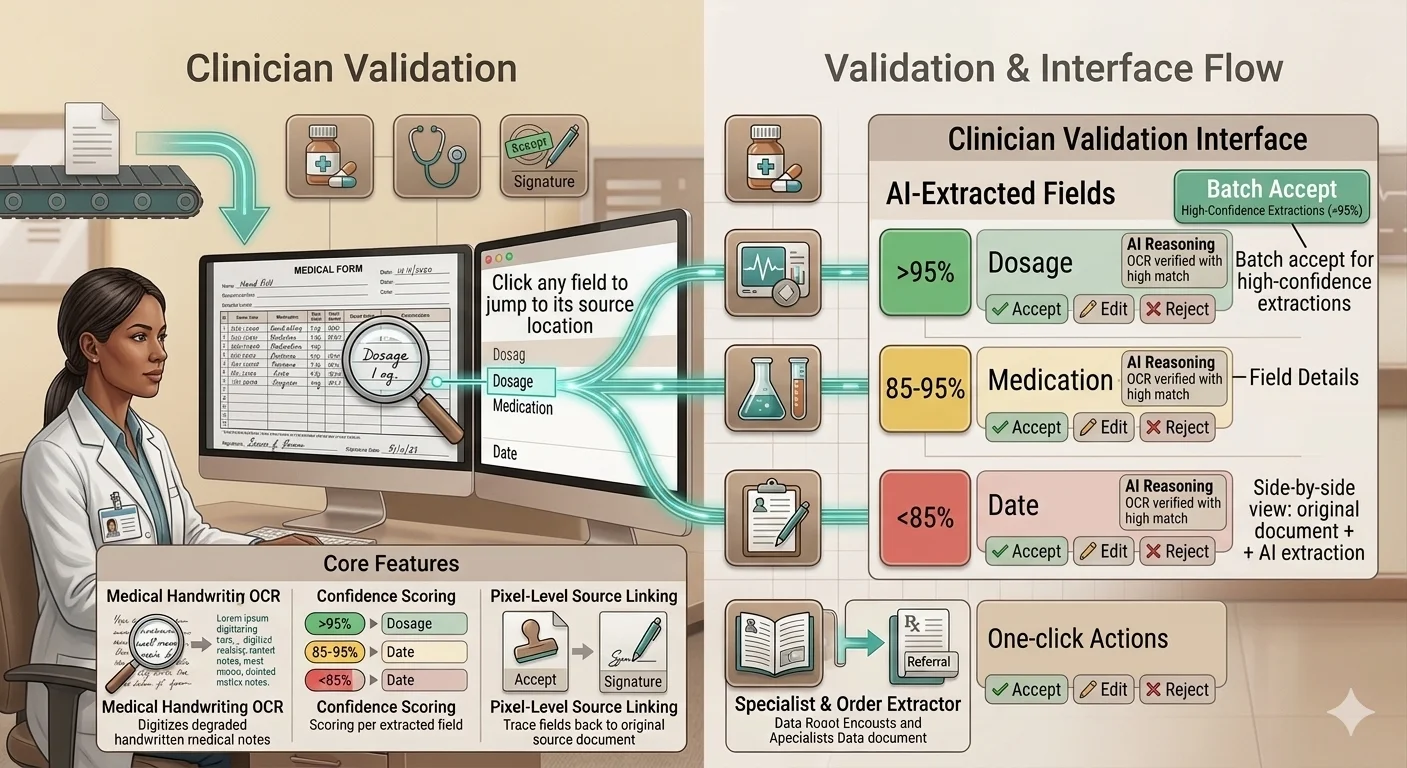
Clinician Validation
Extracted data appears in a side-by-side interface: the original scanned document on the left, AI extraction on the right. Low-confidence values are shown in red. Click any extracted field to jump to its source location on the original document. Accept, edit, or reject each field individually.
- Side-by-side view: original scan and AI extraction
- Click any field to jump to its source in the document
- Low-confidence fields highlighted in red
- Batch accept for high-confidence extractions
- Full authorship chain — who validated, when
- Validation by appropriate role (clinical vs. informatics)
HL7 Export for Epic Import
Once a document is validated, Lumenly generates HL7 v2.x messages or CSV files designed to file via standard Epic import interfaces. Your interface engine receives standard messages. No custom integration project.
- Vitals and I&O: HL7 structured for incoming flowsheet data interfaces
- MAR: standard CSV for downtime medication import
- Provider notes: MDM^T02 with scanned document attachment
- SFTP delivery or portal download — your choice
- Audit trail preserved in exported messages
- Re-export blocked until clinician validation is complete
Specialist AI for every document type
Each document type routes to a purpose-built extractor trained on the specific structure, terminology, and edge cases of that document type. Not a generic extraction model applied to everything.
MAR
Medication Administration Record
Medications, doses, routes, administration times, nurse initials, allergies header
Vitals
Vital Signs Flowsheet
BP, HR, temp, RR, SpO2, EtCO2, pain score, timestamps, documenting RN
I&O
Intake & Output
Fluid types, volumes, output categories, shift totals, fluid balance
Nursing Assessment
Nursing Assessment
System-by-system assessment narrative, care plan, interventions
H&P / Progress Notes
Provider Documentation
Chief complaint, HPI, PMH, ROS, A&P, note type classification
Discharge Summary
Discharge Summary
Discharge diagnoses, disposition, follow-up instructions, discharging provider
Lab Results
Laboratory Report
Test names, results, units, normal ranges, collection timestamps
Imaging Reports
Radiology Report
Exam type, modality, body part, impression, radiologist
CIWA
Alcohol Withdrawal Assessment
CIWA score, 10 sub-scores, nurse attestation
Braden
Pressure Injury Risk
Braden/Braden Q total score, 6 sub-scores, nurse name
Fall Risk
Schmid Falls Risk Assessment
Total score, 5 sub-scores, risk category, nurse name
Critical Care
Ventilator / ICU Flowsheet
Airway details, hourly vent readings, hemodynamics, attestation
Consent Forms
Informed Consent
Patient name, MRN, procedure, documenting clinician, signatures
Orders
Physician Orders
Order text, ordering provider, order datetime, medication name correction
Staff Sign-In Sheet
Downtime Registration Log
Staff names, initials, signatures — auto-linked to signature library
Clinical Safety
Beyond extraction — clinical intelligence built in
Lumenly doesn't just digitize paper charts. It scans every document for safety-critical information, tracks controlled substances, and reconstructs quality metrics — without additional chart abstraction work.
Safety Alerts Dashboard
Every document is scanned for safety-critical information. A per-patient alert panel surfaces anything that requires attention before re-entry into Epic — so your team doesn't miss it in the backfill rush.
- Tier 1 Acute — Allergies, code status, isolation precautions
- Tier 2 Time-Sensitive — Restraints, high-risk new medications, pending consults, new wounds
- Tier 3 Reconciliation — Advance directives, new diagnoses, critical lab interventions
Controlled Substance Audit Trail
Every DEA-scheduled administration captured during downtime appears in a dedicated audit log. A controlled substances pharmacist can review and export in minutes — not hours of manual chart review.
- DEA Schedule II–V tracked per administration
- Drug, dose, route, nurse, and timestamp per entry
- CSV export for pharmacy and DEA compliance review
Quality Metrics Reconstruction
Key regulatory quality measures reconstructed directly from extracted downtime data — no manual chart abstraction. Results include the exact timestamps and data points used, defensible for Joint Commission review.
- Door-to-Needle time (TJC STK-4 / CMS OP-23)
- VTE Prophylaxis (SCIP-VTE-2) — first heparin within 24h
- Pain Assessment (TJC NPSG) — any pain scale reading
- Glycemic Control (NQF 0471) — insulin administration tracking
PHI handled correctly from the first upload
Recovery is a full PHI-scoped environment. Every architectural decision — storage, access, logging, retention — is designed for HIPAA compliance. A Business Associate Agreement is included as standard.
During an active downtime event, Lumenly's 24/7 support team is reachable within 2 hours. We've planned for the scenario where you need help at 2am on a Sunday during a ransomware attack — because that's exactly when downtime events happen.
BAA included as standard. No additional legal negotiation required. Lumenly's BAA covers all PHI processed through the Recovery platform.
HIPAA Compliant
- BAA included
- End-to-end encryption
- Access logging for all PHI
- Role-based access control
- US-only data residency
Audit Trails
- Every action timestamped
- Original documents unchanged
- Clinician authorship chain
- CSV export for legal discovery
Data Retention
- 7-year document retention
- Server-side encryption
- Automated backup
Event Support
- 24/7 during active events
- 2-hour response SLA
- Dedicated implementation manager
- Clinical informatics guidance

Start free.
Upgrade when you need it.
The next outage isn't a matter of if. Generate your downtime kit now — no PHI, no credit card, no contract.